Sera, a 10-year old ethnic Wana, was longing to return to his hamlet, Lipu Salisarao, in the regency’s forest highlands to join his peers at Lipu School, an informal school in the forest settlement.
He has studied for two years in Taronggo, the only nearby village with a public school, around 10 kilometers from Lipu Salisarao. The village is accessible only on foot by trekking through hills and rivers for almost the whole day.
Sera was all smiles when he finally got back to Lipu Salisarao recently. Lipu School teacher Ma’in announced there would be a lesson that afternoon.
“It’s nice to be able to learn again,” said Sera. Ma’in teaches local children how to read.
In fact, Sera is quite literate. He said he missed his local friends and wanted to be among them to boost their spirit. Sera’s cousin, 10-year old Sandi, also shows great interest in the reading lessons.
“Sera is highly motivated,” said Ma’in, adding that Sera was quick to learn and already able to read when Lipu School was only several months old. Some of the local students are older than Sera but very passionate about learning.
“Lessons can’t just be given in the room. We use the method of playing games outdoors. Study time is also adjusted to the opportunity available. Sometimes there’s no class when children have to follow their parents to the fields,” Ma’in said.
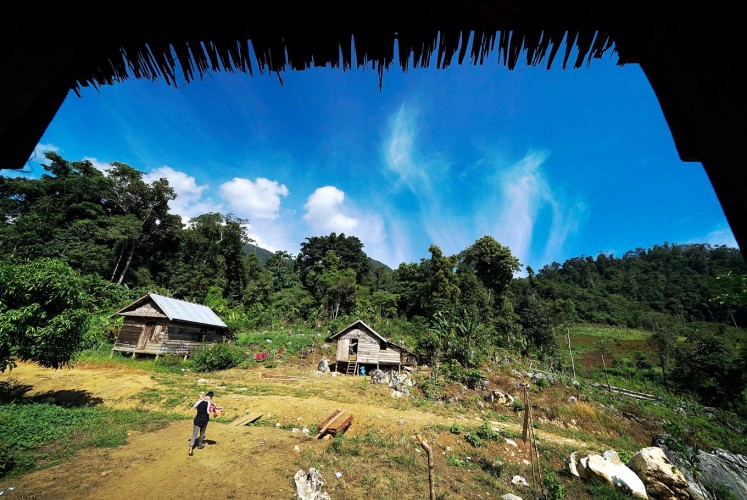 Better than nothing: One of the schools located in the remote forest of North Morowali regency in Central Sulawesi. (JP/Syafrizaldi)
Before sunset, Ma’in took his students to the yard for a traditional game. He instructed them to draw a circle on the ground with a wooden stick and one student outside had to touch those inside the circle until only one was left. It was a geometry game to acquaint them with a circle’s circumference and diameters.
In another game session, Sera chose to play rope skipping. In Salisarao, this game uses rattan for the rope. He and his two peers were assigned to prepare the rattan and measure its length before playing. “This will enable children to understand measurements,” said Ma’in.
Later Sera changed the game to marbles, which were crafted by Sandi from coconut shells and placed within a small circle. Then Sera made a 2-meter straight line from the circle and put one marble on the line, which was to be pushed with a bamboo stick to the exact center of the circle.
“This game is about distance and energy,” said Ma’in. But he used the term power for the children instead of energy, which was the power they employed to fling the marble to cover the right distance at the right time. “We learn mathematics and physics at the same time,” noted Ma’in.
To be able to provide creative learning experiences like Ma’in does, Lipu School teachers need to broaden their knowledge and assisting in this is Yayasan Merah Putih (YMP), an advocacy foundation in Palu, Central Sulawesi.
“Lipu School is an alternative school to teach children to read, do arithmetic and gain general knowledge. It’s based on the concept that all places are classrooms, all residents are teachers and all experiences serve as study material,” YMP executive director Amran Tambaru said.
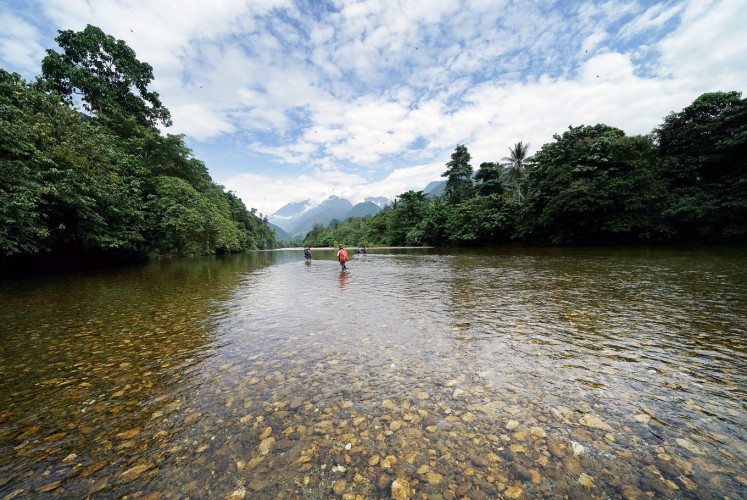 Dedication: Teachers at the remote forest of North Morowali regency in Central Sulawesi have to go through challenging natural terrains to reach the schools in which they teach the Wana Posangke community people. (JP/Syafrizaldi)
This principle has made a lot more people eager to learn. In some areas with such schools, according to Amran, adult students are common. The YMP has developed at least seven Lipu schools in the Wana Posangke community zone.
“Through literacy, they hope they won’t be deceived when selling non-wood forest products, also when struggling for their rights as traditional community members,” said Amran.
Meanwhile, Ma’in said that in learning, the socio-cultural aspects of Wana people had often been discussed so as to preserve the typical characteristics of the community. Therefore, he describes the various traditions and customs of the ethnic Wana group to his students, including the utilization of land.
United States anthropologist Michael Alvard in his notes entitled “The potential for sustainable harvests by traditional Wana hunters in Morowali Nature Reserve, Central Sulawesi, Indonesia” and “The impact of traditional subsistence hunting and trapping on prey populations: Data from the Wana of upland Central Sulawesi, Indonesia, 2000”, showed that the use of land by Wana people was not expansive nor exploitative.
Based on the notes, a Wana household uses no more than a hectare of land for agriculture. The land already includes the plots for main and secondary food crops, also for the rotation of farms with the cycle maintained within one to five years.
“We the people of Wana will return to our previous farms after being abandoned. So there’s no such thing as nomadic farming referred to by urban people. We’re convinced that the former fields will again be fertile for paddy planting,” assured Ma’in.
Wana people, according to Ma’in, know the grouping of paddy fields, which comprises Tou for five-month-old paddy and Bonde for three-month-old paddy. There’s no mechanization, no fertilizer, everything is traditionally handled.
However, within the five years many changes happen. Sometimes the fields they left have turned into oil palm estates or mining areas.
“This is the source of conflict. So it’s important for Wana people to learn to read and do arithmetic,” Ma’in said.
Amran Tambaru confirmed Ma’in statement. He and the YMP are striving to secure the survival of future Wana generations amid the intense exploitation of natural resources. “Despite the recognition of the 6,212-hectare Wana Posangke Traditional Forest, it doesn’t yet ensure Wana people’s future welfare,” said Amran.
It’s worth noting that President Joko “Jokowi” Widodo has handed over the Decision on the Recognition of the 6,212-ha Wana Posangke Traditional Forest through the 2016 Decree of the Minister of Environment and Forestry.
“Sera’s generation will be the Wana population’s cultural successor. It’s thus important for members of the generation to become smart people. Reading, writing and arithmetic are the basic key to their progress,” Amran said.
source: http://www.thejakartapost.com


