Showing posts with label Education. Show all posts

Saturday, 17 March 2018

For the more liberal-leaning Indonesians, the upcoming revision to the Criminal Code (KUHP), currently being finalized by the House of Representatives and the President Joko "Jokowi" Widodo administration, is a threat to freedom. Lawmakers and government officials, however, have played down such concerns, saying the new KUHP was principally meant to create order in society and should by no means be perceived as an attempt to encroach on an individual’s privacy. 
The Jakarta Post's Ina Parlina, Margareth S. Aritonang and Moses Ompusunggu recently spoke with Enny Nurbaningsih, who heads the government team tasked with formulating the KUHP bill, on the philosophy and aim behind the revision to the 70-year-old law. Following are excerpts from the nearly hour-long interview.
Question: How is the KUHP bill more progressive than the colonial criminal law?
Answer: The KUHP bill consists of two parts: the first book and the second book. The first book explains the guidelines for punishment that are different from the Dutch colonialist KUHP. We changed the guidelines because our focal point is not to punish a perpetrator for their deed, but to correct the perpetrator.
Therefore, a perpetrator we want to correct does not necessarily have to be sentenced to jail. [The correction] could be adequately made through community service or supervision by authorities. We have to pay close attention to the perpetrator.
We expect the guidelines in the first book will be used by law enforcement agencies in our country. Another point is how to apply the death penalty, which is starkly different from the old KUHP.
The old KUHP recognizes the death penalty as capital punishment, which makes it easier for [judges] to hand down a death sentence. This will no longer be easy, because the upcoming revision aims at correcting the perpetrator.
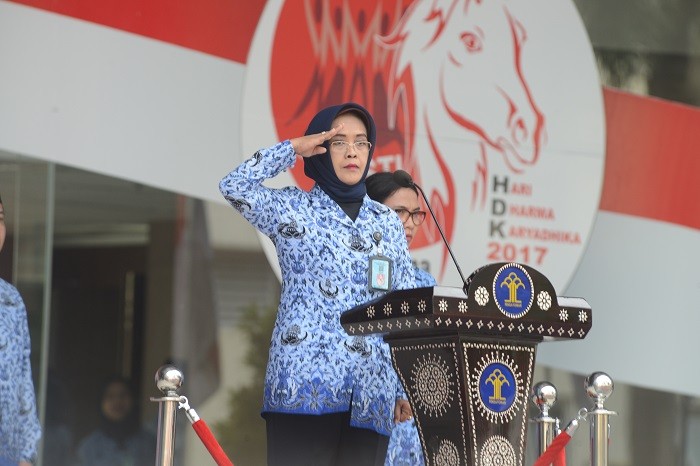
Enny NurbaningsihEnny Nurbaningsih (Courtesy of//kemenkumham.co.id)
The restorative justice concept used in the KUHP bill is based on human rights principles, but our judges are still using conventional legal thinking in determining verdicts. Can the concept be implemented?  
That's why we need a transition period to disseminate and to prepare the infrastructure and human resources for the implementation of the new KUHP. We will also ready the people who will be in charge of managing the implementation of community service as punishment. We have to be ready for everything.
[Even when all preparations are ready], it will not mean we can relax, as our journey will be arduous. This is the start of a very different thing.
How long will the transition period be?
Three years. The House argued it was too long, but it would be difficult [to shorten the duration] because we have to disseminate [the new KUHP] to our law enforcement authorities, to civil society organizations, to everyone. 
We will ask the CSOs for help in the dissemination, because all citizens must be well informed about the penal code. We have to have the same understanding, so that we know what and how to do things when we are in trouble. It's dangerous for the country if its citizens don't understand their penal code system.
Some people ask, "Why is the deliberation of the KUHP bill conducted haphazardly?" In what way? The draft bill was first initiated in 1964, developing over time [to the version] we are using now, the 2015 version.
Moreover, if you monitored the drafting process, you would be able to observe the changes that were made. We have made the changes because we have to be very careful in revising the KUHP, which is applicable to all citizens.
That's why we involved a lot of experts in the process. There is [not a single ounce] of elitism in it. All hearings are open to the public, different from the deliberation on the terrorism bill, which is virtually “closed door”, because it talks about intelligence data.
We have even conducted roadshows to various universities to explain the bill’s contents. We have also invited proofreaders to check the contents.
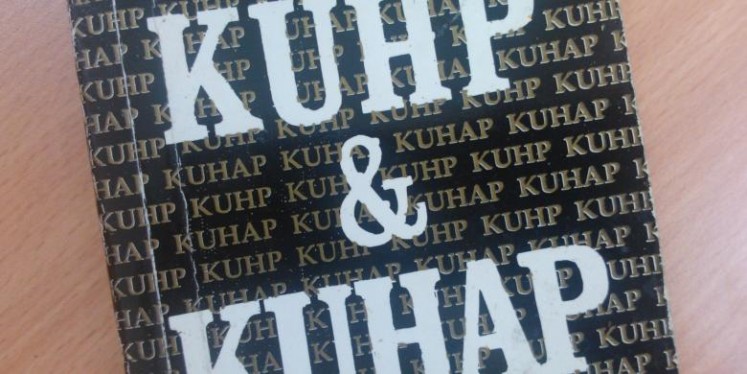
An Illustration of the Indonesian Criminal Code (KUHP). An Illustration of the Indonesian Criminal Code (KUHP). (kompas.com/Palupi Annisa Auliani)
Who are the proofreaders? And what did they actually do?
They corrected the substance. All are criminal law professors.
We did all this because we think this bill should be the constitution for Indonesia's criminal law, which will regulate how punishment should be given, among other [provisions]. We were very prudent in drafting it.
Did lawmakers and government officials make many changes? 
There were changes made at every hearing on the bill. I cannot count all the changes because there are many. Our speed in deliberating the bill was normal, because we have to prevent conflict with other regulations of criminal law. We are very careful in that.
But it does not mean we have no target at all. Having a target is very different from doing it haphazardly. Our target is that the revision process would be concluded under the current House session. Failing that, it's possible that the bill would not be deliberated again, because everything depends on the political decision of the next [legislative] session.
It's possible that we could start all over again because our lawmaking system at the House does not allow carryover [legislation]. Just count the losses – financial and energy-wise – if we restarted the deliberation from zero.
On the other hand, creating an original criminal code has been the state's commitment since Independence. It is part of our law reform effort: replacing Dutch colonialist regulations, which number around 400 regulations at present.
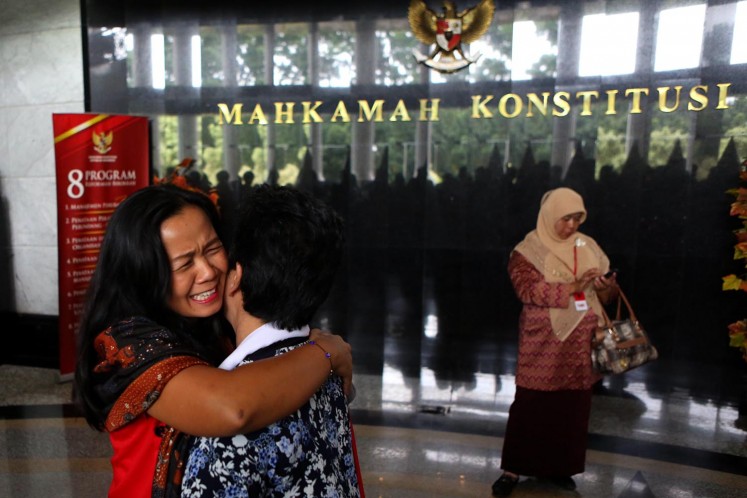
A women's rights activist cries with joy after the Constitutional Court (MK) rejected a judicial review petition demanding that articles on adultery in the prevailing Criminal Code be expanded to include pre-marital sex and same-sex relationships in this Dec. 14, 2017, file photo. A women's rights activist cries with joy after the Constitutional Court (MK) rejected a judicial review petition demanding that articles on adultery in the prevailing Criminal Code be expanded to include pre-marital sex and same-sex relationships in this Dec. 14, 2017, file photo. (JP/Seto Wardhana.)
How do you respond to the criticism over the homosexuality articles in the criminal code bill?
You have to understand that LGBT was regulated in the Dutch criminal code, though it only regulates crimes committed against underage victims.
For the new regulation, we cannot [criminalize] a person [for his or her sexual orientation]. Instead, what we regulate is their [sexual practice], whether it is conducted in private or in public.
We are prohibited from raiding dormitories one by one to see whether or not there are two people in the same room. That is a private matter.
For the Republic of Indonesia, it is not possible for the government to intrude on the private matters of its citizens. But when private matters disrupt public matters, we have to enforce the law. For instance, when a person [engages in LGBT practices] to disrupt public order. We are not a liberal country.
But the morality articles are open to different interpretations.
We cannot measure it subjectively, because it is related to morality. At the end, it is the judges who will assess [each case]. The legal process at this stage must be very strong.
Besides, one can also be charged with a crime of homosexuality if one commits it by spreading pornographic content, especially if the victim is a child; the sentence would be very heavy. We are aware that the distribution of pornographic content has been rampant here.
So the implementation of the new KUHP provisions depends on the capability of individual judges?
Not only the new norms, but all provisions in the criminal code. The judges will also decide whether to sentence a convicted criminal to jail or only to community service.
The implementation of the community service sentence could also address the problem of overcrowded prisons. For instance, when one person is sentenced to one year in prison, it is possible for the sentence to be replaced with community service or supervision by authorities; or even with a mere fine. The community service sentence, however, cannot be applied to serious crimes.
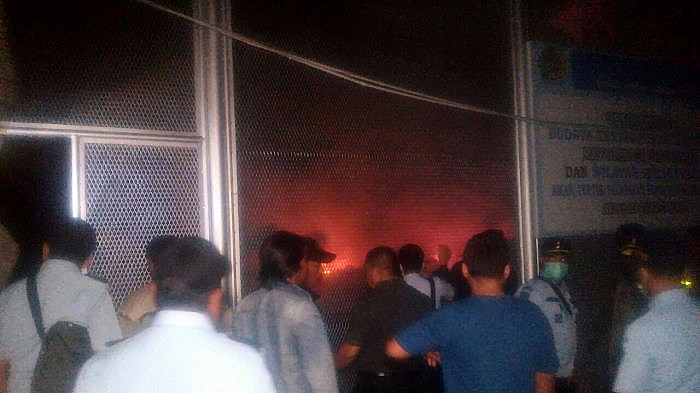
Burned down: A fire razes the Jambi Class II A Penitentiary during a riot in March last year.Burned down: A fire razes the Jambi Class II A Penitentiary during a riot in March last year. (Courtesy of Tribunnews.com/File)
Some NGOs said the increasing number of crimes regulated in the criminal code bill would increase the current problem of prison overcrowding.
We have to bear in mind that the biggest contributor to prison overcrowding is drug convicts, at around 80 percent.
The Narcotics Law must be revised. We have drug dealers and users, but should we sentence them all to prison? We have to decide which who is better placed in a rehabilitation center, to be placed in prison, or even to receive the death penalty. Regarding the death penalty, we have decided that it is an alternative punishment.
What do you mean by ‘alternative punishment’?
An “alternative and special punishment” means it is dependent on what we call the probation period. For instance, if a death-row convict behaves well during the period, say 10 years, [a death sentence] could be replaced with a life sentence.
What about the adultery articles?
There is an expansion from the old criminal code that criminalizes only sexual acts outside marriage by married individuals.
We want to accommodate the needs of our heterogeneous society that holds [its own] values. We cannot equate our society with Western societies that have broader freedoms, like Europe. We have our own cultural values.
After we decided that the crime can also be reported by any affected third party, it triggered widespread debate. Komnas Perempuan [National Commission on Violence Against Women] was even concerned that it could prompt the persecution of women.
Afterwards, we decided to limit the “third party” definition to the parents, a husband or a wife, or a child of the person who commits adultery.
The restriction has been added to the article. Komnas Perempuan was present at the hearing when we changed the article, and said that they agreed on the matter.
What about the articles on insulting the head of state?
We are bound to the basic principle that the right to freedom of expression is protected under the Constitution. We don't want it to be curtailed by the existence of a new KUHP.  
What is regulated in the new KUHP is different from the last one [the Constitutional Court abolished it in 2006]. We have provided an exclusion on people who cannot be prosecuted using the article. For instance, the article cannot be applied to a person who expresses an opinion or criticism on a government policy.
What we mean by “insult” is when a person degrades the dignity of a head of state. For instance, by calling the head of state “a dog” or anything that is not related to what a president does. We have created a long explanation on this matter, so that law enforcement authorities can differentiate between an insult and criticism.

source: www.thejakartapost.com

Indonesia: We are not a liberal country

Friday, 16 March 2018

WATER: FILTERING DIRTY WATER TO BE CLEAR WITH SIMPLY WAY

Same like before, we greeting the day with happiness. Time to teach the kids and playing with them. Knowledge and lesson new this time we are taking lesson about filter dirty water to be clear with simply way. The teachers already prepare all practice of equipment for the kids.  We only need plastic of bottle more less 3 bottles, dirty water and gravels. After that, we begin to practice the all materials. The kids are not patient to look the practice.

In front on class the teacher will begin to choice materials for first to put in the bottle.  The Teacher explains it with slowly one by one in order the kids can understand. And then the teacher takes a bottle and cut it become two part unequal big one and other. After that one side bottle put turn inside out then put above of bottle into other cut of bottle and then all gravels put in the bottle then pour the water into to bottle pass through the gravels. The teacher does it again and again till get clean of water.


My conclusion: parents always give the best way for them from infancy because the kids very easy to memories whatever they get around of environment. As a parent had better lead them not ignore them. Parents must more creative and clever using all materials around their lives. From nature we shall get many lessons, love your nature and you can see what happen the further.


posted by Lina

LEARN ABOUT FIVE OF ELEMENTS IN THE EARTH PART II

Tuesday, 13 March 2018


House Smart, 13 March 2018


In the morning Friday when the sunshine bright so warm. As usually we came for teaching in house smart. This time we learned about “AIR”. We introduced about air to the kids and worthwhile of air. Example for this time our taken from balloon. The balloon very easy earn from market or shop and no dangerous for kids.

The teachers teach and explain to kid how their get and function of the air beside breathe for other human being. Such as birds that always does the air for flying, ship for sailor in the sea, turbine for electricity and else. In here the teacher using balloons for explaining how the balloons can fly in the air. The balloons blown up by kids as big as they can blow up and then pull it with ring rubber or same like that, every kids has different colour of balloons, I can see that their very enjoyable the lesson.

Before the teacher closed the class, the teachers always inquire a question for help them don’t forget about this lesson. As a prize, they get a cake or snack. So with the way, we can know which one student understand or misunderstand about what teacher taught before. We also can see about memory of them.


 Every Friday we always taught different lesson to them, in order them could learn something a new. We want the kids can get lesson from young age, slowly but sure.
My conclusion about this lesson is we can learn anything around we live without need expensive equipments. This is simple life not complicate. Teach the child as easy as impossible you know and you can see the next what happen to the further.

Thanks for read. JJJJJ

Author by myself


AIR IN THE BALOONS

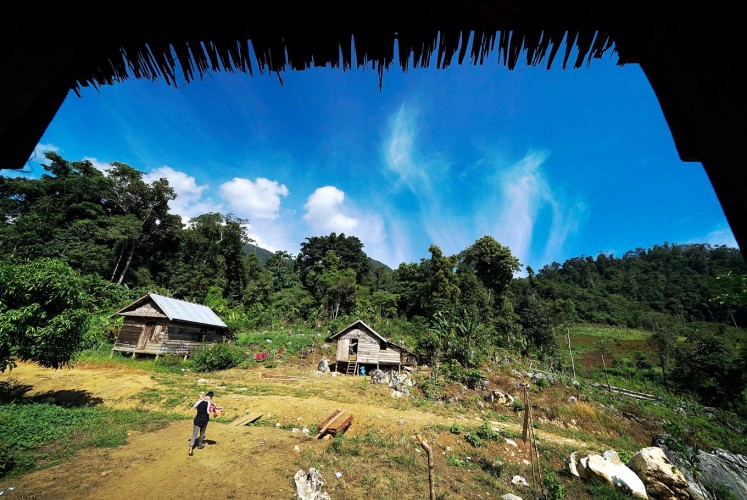
Sera, a 10-year old ethnic Wana, was longing to return to his hamlet, Lipu Salisarao, in the regency’s forest highlands to join his peers at Lipu School, an informal school in the forest settlement.
He has studied for two years in Taronggo, the only nearby village with a public school, around 10 kilometers from Lipu Salisarao. The village is accessible only on foot by trekking through hills and rivers for almost the whole day.
Sera was all smiles when he finally got back to Lipu Salisarao recently. Lipu School teacher Ma’in announced there would be a lesson that afternoon.
“It’s nice to be able to learn again,” said Sera. Ma’in teaches local children how to read.
In fact, Sera is quite literate. He said he missed his local friends and wanted to be among them to boost their spirit. Sera’s cousin, 10-year old Sandi, also shows great interest in the reading lessons. 
“Sera is highly motivated,” said Ma’in, adding that Sera was quick to learn and already able to read when Lipu School was only several months old. Some of the local students are older than Sera but very passionate about learning.
“Lessons can’t just be given in the room. We use the method of playing games outdoors. Study time is also adjusted to the opportunity available. Sometimes there’s no class when children have to follow their parents to the fields,” Ma’in said.
Better than nothing: One of the schools located in the remote forest of North Morowali regency in Central Sulawesi.Better than nothing: One of the schools located in the remote forest of North Morowali regency in Central Sulawesi. (JP/Syafrizaldi)
Before sunset, Ma’in took his students to the yard for a traditional game. He instructed them to draw a circle on the ground with a wooden stick and one student outside had to touch those inside the circle until only one was left. It was a geometry game to acquaint them with a circle’s circumference and diameters.
In another game session, Sera chose to play rope skipping. In Salisarao, this game uses rattan for the rope. He and his two peers were assigned to prepare the rattan and measure its length before playing. “This will enable children to understand measurements,” said Ma’in.
Later Sera changed the game to marbles, which were crafted by Sandi from coconut shells and placed within a small circle. Then Sera made a 2-meter straight line from the circle and put one marble on the line, which was to be pushed with a bamboo stick to the exact center of the circle.
“This game is about distance and energy,” said Ma’in. But he used the term power for the children instead of energy, which was the power they employed to fling the marble to cover the right distance at the right time. “We learn mathematics and physics at the same time,” noted Ma’in.
To be able to provide creative learning experiences like Ma’in does, Lipu School teachers need to broaden their knowledge and assisting in this is Yayasan Merah Putih (YMP), an advocacy foundation in Palu, Central Sulawesi.  
“Lipu School is an alternative school to teach children to read, do arithmetic and gain general knowledge. It’s based on the concept that all places are classrooms, all residents are teachers and all experiences serve as study material,” YMP executive director Amran Tambaru said.
Dedication: Teachers at the remote forest of North Morowali regency in Central Sulawesi have to go through challenging natural terrains to reach the schools in which they teach the Wana Posangke community people.Dedication: Teachers at the remote forest of North Morowali regency in Central Sulawesi have to go through challenging natural terrains to reach the schools in which they teach the Wana Posangke community people. (JP/Syafrizaldi)
This principle has made a lot more people eager to learn. In some areas with such schools, according to Amran, adult students are common. The YMP has developed at least seven Lipu schools in the Wana Posangke community zone.
“Through literacy, they hope they won’t be deceived when selling non-wood forest products, also when struggling for their rights as traditional community members,” said Amran.
Meanwhile, Ma’in said that in learning, the socio-cultural aspects of Wana people had often been discussed so as to preserve the typical characteristics of the community. Therefore, he describes the various traditions and customs of the ethnic Wana group to his students, including the utilization of land.
United States anthropologist Michael Alvard in his notes entitled “The potential for sustainable harvests by traditional Wana hunters in Morowali Nature Reserve, Central Sulawesi, Indonesia” and “The impact of traditional subsistence hunting and trapping on prey populations: Data from the Wana of upland Central Sulawesi, Indonesia, 2000”, showed that the use of land by Wana people was not expansive nor exploitative.
Based on the notes, a Wana household uses no more than a hectare of land for agriculture. The land already includes the plots for main and secondary food crops, also for the rotation of farms with the cycle maintained within one to five years.
“We the people of Wana will return to our previous farms after being abandoned. So there’s no such thing as nomadic farming referred to by urban people. We’re convinced that the former fields will again be fertile for paddy planting,” assured Ma’in.
Wana people, according to Ma’in, know the grouping of paddy fields, which comprises Tou for five-month-old paddy and Bonde for three-month-old paddy. There’s no mechanization, no fertilizer, everything is traditionally handled.
However, within the five years many changes happen. Sometimes the fields they left have turned into oil palm estates or mining areas.
“This is the source of conflict. So it’s important for Wana people to learn to read and do arithmetic,” Ma’in said.
Amran Tambaru confirmed Ma’in statement. He and the YMP are striving to secure the survival of future Wana generations amid the intense exploitation of natural resources. “Despite the recognition of the 6,212-hectare Wana Posangke Traditional Forest, it doesn’t yet ensure Wana people’s future welfare,” said Amran.
It’s worth noting that President Joko “Jokowi” Widodo has handed over the Decision on the Recognition of the 6,212-ha Wana Posangke Traditional Forest through the 2016 Decree of the Minister of Environment and Forestry.
“Sera’s generation will be the Wana population’s cultural successor. It’s thus important for members of the generation to become smart people. Reading, writing and arithmetic are the basic key to their progress,” Amran said.

source: http://www.thejakartapost.com

Wana's new generation guarantees sustainable resources

Sunday, 11 March 2018

Samsung bakal Pertimbangkan AR Emoji Hijab


Jakarta - AR Emoji jadi salah satu fitur unggulan yang ditawarkan Galaxy S9 dan S9+. Sayangnya, fitur tersebut belum menyediakan opsi hijab seperti emoji pada umumnya. 

Pertanyaan itu coba detikINET tanyakan kepada IT & Mobile Marketing Director Samsung Electronics Indonesia Jo Semidang. Dia mengatakan, memang pihakya belum menghadirkan opsi hijab pada AR Emoji, lantaran dirilis global.

Tapi dia menilai usulan AR Emoji hijab sangat menarik. Jo akan coba menyampaikan hal tersebut ke pihak riset dan pengembangan Samsung.

"Kami akan mencoba mengakomodir saran tersebut ke tim riset dan pengembangan. Bilamana jadi, bisa menjadi opsi aksesori di AR Emoji," kata Jo usai acara peluncuran Galaxy S9 dan S9+ di Jakarta.

"Tapi penambahan opsi di AR Emoji tidak cepat. Butuh waktu cukup lama untuk melakukan pengembangan," tambahnya.

Untuk diketahui, AR Emoji memungkinkan kita membuat emoji berupa avatar wajah kita sendiri. Dalam menciptakan emoji wajah ini, Galaxy S9 dan S9+ memanfaatkan Intelligent Scan yang dibenamkan di kamera depannya. 

Dengan demikian, kamera bisa menciptakan pemetaan 3D sesuai karakteristik dan ciri khas wajah kita, dan menampilkannya dalam bentuk karikatur yang kemudian dijadikan emoji. Asyiknya, kita dapat mengirimkan AR Emoji ke WhatsApp atau instant messaging lainnya dalam bentuk GIF.

Samsung bakal Pertimbangkan AR Emoji Hijab Foto: Rachmatunnisa
Adapun cara membuat AR Emoji sebagai berikut:

1. Buka kamera di Galaxy S9 atau S9+, kemudian pilih menu AR Emoji pada bar di bagian atas laya

2. Tempatkan wajah di area bulat yang ditampilkan di layar. Kemudian tap tombol shutter untuk mengambil gambar seperti ketika sedang selfie. Untuk hasil maksimal, Samsung merekomendasikan agar melepas kacamata bagi yang menggunakannya. 

3. Setelah itu, pilih gender 'Male' atau 'Female', lalu tap tombol 'Next'. 

4. Tunggu sesaat, Galaxy S9 atau Galaxy S9+ akan mulai membuatkan AR Emoji wajah kita. Jika sudah selesai, kita bisa mendandani karakter kita sesuai keinginan. 

5. Jika AR Emoji dirasa sudah cukup memuaskan, tap 'Ok'. Selanjutnya akan muncul notifikasi yang memberitahukan emoji kita sudah tersedia dalam bentuk sticker di keyboard pada ponsel Galaxy S9 dan S9+ yang digunakan. 

6. AR Emoji pun sudah jadi dan siap digunakan.

GEDGET

Friday, 3 November 2017


November 3rd , 2017


KEGIATAN NGAJAR-MENGAJAR DI PERUM GPI-TIBAN INDAH


melihat kebahagiaan mereka saat belajar dan antusias dalam menerima pelajaran adalah hal paling menyenang agi seorang  guru. Minat belajar diimbangi dengan membaca dan praktek dalam pengajaran membuat anak-anak tidak bosan dalam melakukan kegiatan ngajar mengajar ini, setiap akhir sesi guru selalu memberikan test dengan cara yang lain dari yang lain, sambil bermain tidak menyulitkan mereka untuk belajar. Tentu bermain disini bukan bermain yang biasa di lakukan antar sesama mereka. Bermain disini adalah mengajak mereka ikut terlibat dalam game atau quiz yang tidak memberatkan mereka.

Sebagai seorang guru harus pandai-pandai melihat situasi dan kondisi yang sedang berlangsung saat ngajar mengajar, agar tidak ada waktu yang monoton sehingga anak-anak semakin tertarik belajar.

Di tempat tinggal ku, kami selalu melakukan les bahasa inggris setiap hari minggu. Melihat jumlah mereka belajar dari waktu ke watu semakin ramai membuat saya menjadi semangat mengajarnya. Bearti apa yang sudah di lakukan sangat berkesan oleh mereka, kegiatan ini memang sengaja di lakukan saat minggu sore sehingga mereka santai menjalaninya, tentu ini tidak ada unsur paksaan untuk wajib datang setiap minggu. Tapi ini semua murni niat anak-anak itu sendiri yang sangat tertarik belajar bahasa inggris.

Saya dan segenap guru-guru di komplek ini sangat berterima kasih kepada seluruh anak-anak ini, karena kehadiran dan antusias mereka dalam belajar sangat besar. Ini segelintir generasi baru yang masih kuat dalam menimba ilmu ditengah-tengah pesatnya kemajuan tekhnologi.


KEGIATAN NGAJAR-MENGAJAR DI PERUM GPI-TIBAN INDAH

Monday, 30 October 2017

KNITTING, WEAVING AND ADHERING

This week lesson about KNITTING AND ADHERING; Knitting is a method by which yarn is manipulated to create a textile or fabric for use in many types of garments. As beginning Knitters they were enough patients to learn it. Not easy be a knitter this needs many time to get the purpose, they have been meeting twice to learn it. I admitted that I was jealous with them, where they able to do it in meeting twice. Bravo for them, this smart house not only for learn kids but also for their parents. With this method we can empower good society with good skill also.

This lesson has been leaded by Buk Iluh and her friends. With pleasure Buk Iluh teach them step by step, thanks for Buk Iluh already sharing her knowledge. And for them (housewives) enthusiastically accept  this new knowledge, with this they not only stay at home without do anything, start right now they can development themselves and also able to sell result of them creation, this was good solution to help their husband in economic. Not forget this lesson always doing every Friday.


Beside that any other activity already they done, the activity was WEAVING; WEAVING were made from materials like cotton, silk with gold and silver yarn as well as fibers of local plants and trees. But in here smart house we use wearing were from goods second such as plastics of beverage or others same plastics. You can see result of the weaving this below.


 Early Childhood teachers were teaching adheres, these adhering were using colored paper and scissors for cuts paper that. The teacher teaching cut of colored paper be medium of pieces and then adhere on others paper. The children do it joy and cheers, each meeting has new lesson give for them.  


KNITTING, WEAVING AND ADHERING

Wednesday, 25 October 2017

 Wednesday, October 25, 2017

SMART HOUSE IN BATAM

LESSON ABOUT ENGLISH USING BE AND “ARABIC MALAY”

Giving something valuable for them as long as you can breathe in this earth because of the time cannot await. Helping one another can make you feel very comfort, ability you have don’t you throw without result. My this article I show it for them who had been helping all programs in smart house, we start from zero to hero for them, one by one the children came to smart house unanimous they doing one step for coming the place for get more knowledge beside their school.

This time I am going to teach about English and Arabic Malay lesson, both of them have homework about it, where I should help them for finishing their homework one by one, this was awesome, for first stepping I teach them with English lesson about “USING BE”, I just continuing their lesson with teacher before, where the teacher already taught them formula to build a sentence with “S + TO BE + ADJECTIVE, ADJECTIVE AND NOUN. And now I just continue with Negative BE (adding NOT).

Second lesson about Arabic Malay, even though they were not from Muslim, they kept learn Arabic Malay, in here we can see that this smart house can bring together of them with other side life, with this event we can aware that difference cannot be separated with them one another. When I look them to learn the lesson it. my felt very cheer and joy about it, I expected the children ability to receive this lesson with very well and also hope all people has same mind and commitment to keep teach them.

Indeed, these all should do with pleasure heart not others. Because they were deserve it. These children were new generation for this country and they deserve same thing with other children without difference. I hope with this an article I can help them more than this.

In here I also take some of photos about their residential environment.


LESSON ABOUT ENGLISH USING BE AND “ARABIC MALAY”

Saturday, 21 October 2017

Friday, October 20, 2017
BATIK LESSON

Lesson this morning at smart house about BATIK, BATIK is at one art famous from Indonesia, batik from all provinces in Indonesia but mostly from java, every province has different motive, each motive has different purpose also. As Indonesian Our try to introduce the Batik to children from now, when they still childhood, we started with easy example. We used tissue as first object, because tissues easier than others object to absorb of liquid. And for colouring our use food colouring, so it’s safe for their use.

Each child got chance for making theirs batik, they were very enthusiasms for following these lesson. These practices did by others teachers, they were new teachers, I myself so proud with all they have been doing with these smart house special for children every meeting we all have new lesson for them. I expected for next meeting the children could came more than this, because they still need encouragement not only from teacher but also their parents.

We all here supports their parents for good activities instance are building good communication one another with do other activities for them. Besides that, in here we also inviting them with do increase other skill beside be a housewife. For these activities we have other special teacher with excellent skill they are Buk Illuh teacher of knit,Buk Lastri Simbolon, Buk Maryati, Hasanah, and Helwina are early childhood Teachers, Buk Lastri not only early childhood teacher but also for elementary teacher, Buk Eko, and her friends teacher special for religion and also knit. In here created togetherness each other even though we all have difference race, religion, skin and outlook.

You all can see all our activities in smart house Batam with these photos and a video.


SMART HOUSE IN BATAM

Wednesday, 18 October 2017

SMART HOUSE IN BATAM

Education is very important for all peoples where each of them can get it in whenever they are invariably.  I expect education can belongs all children, because of that I write this an article.

There were my activities at “smart house” I became a teacher in there, I have been teaching more less 3 months. Many experiences I found in there, as long as I taught in there I saw many of people need helps special for children, One of problem this education when they have not enough money to pay the school fee, such I seen before there still has children, where they quit school  in progress . I found a case like that, when I went to their place. The first problem there at jobs, mostly parents of students lost their jobs in because of leastwise vacancy in here.

Mostly of them work in house assistant and scavenger, even so, they still keeping spirit looking money for sending their children to school until finish. As I know their parents work not far from their place. Nevertheless, I and other teacher very happy to teach them and we can share knowledge our have. we can see all smile of them by these photos


Smart House in Batam

 
LIFESTYLE AND SOCIAL © 2015 - Blogger Templates Designed by Templateism.com