For the more liberal-leaning Indonesians, the upcoming revision to the Criminal Code (KUHP), currently being finalized by the House of Representatives and the President Joko "Jokowi" Widodo administration, is a threat to freedom. Lawmakers and government officials, however, have played down such concerns, saying the new KUHP was principally meant to create order in society and should by no means be perceived as an attempt to encroach on an individual’s privacy.
The Jakarta Post's Ina Parlina, Margareth S. Aritonang and Moses Ompusunggu recently spoke with Enny Nurbaningsih, who heads the government team tasked with formulating the KUHP bill, on the philosophy and aim behind the revision to the 70-year-old law. Following are excerpts from the nearly hour-long interview.
Question: How is the KUHP bill more progressive than the colonial criminal law?
Answer: The KUHP bill consists of two parts: the first book and the second book. The first book explains the guidelines for punishment that are different from the Dutch colonialist KUHP. We changed the guidelines because our focal point is not to punish a perpetrator for their deed, but to correct the perpetrator.
Therefore, a perpetrator we want to correct does not necessarily have to be sentenced to jail. [The correction] could be adequately made through community service or supervision by authorities. We have to pay close attention to the perpetrator.
We expect the guidelines in the first book will be used by law enforcement agencies in our country. Another point is how to apply the death penalty, which is starkly different from the old KUHP.
The old KUHP recognizes the death penalty as capital punishment, which makes it easier for [judges] to hand down a death sentence. This will no longer be easy, because the upcoming revision aims at correcting the perpetrator.
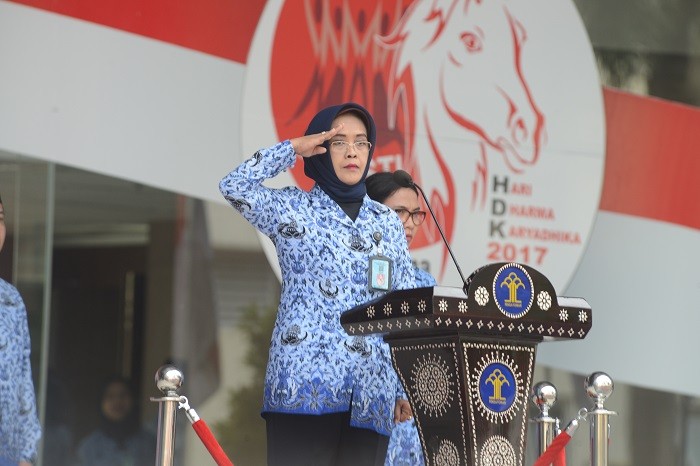 Enny Nurbaningsih (Courtesy of//kemenkumham.co.id)
The restorative justice concept used in the KUHP bill is based on human rights principles, but our judges are still using conventional legal thinking in determining verdicts. Can the concept be implemented?
That's why we need a transition period to disseminate and to prepare the infrastructure and human resources for the implementation of the new KUHP. We will also ready the people who will be in charge of managing the implementation of community service as punishment. We have to be ready for everything.
[Even when all preparations are ready], it will not mean we can relax, as our journey will be arduous. This is the start of a very different thing.
How long will the transition period be?
Three years. The House argued it was too long, but it would be difficult [to shorten the duration] because we have to disseminate [the new KUHP] to our law enforcement authorities, to civil society organizations, to everyone.
We will ask the CSOs for help in the dissemination, because all citizens must be well informed about the penal code. We have to have the same understanding, so that we know what and how to do things when we are in trouble. It's dangerous for the country if its citizens don't understand their penal code system.
Some people ask, "Why is the deliberation of the KUHP bill conducted haphazardly?" In what way? The draft bill was first initiated in 1964, developing over time [to the version] we are using now, the 2015 version.
Moreover, if you monitored the drafting process, you would be able to observe the changes that were made. We have made the changes because we have to be very careful in revising the KUHP, which is applicable to all citizens.
That's why we involved a lot of experts in the process. There is [not a single ounce] of elitism in it. All hearings are open to the public, different from the deliberation on the terrorism bill, which is virtually “closed door”, because it talks about intelligence data.
We have even conducted roadshows to various universities to explain the bill’s contents. We have also invited proofreaders to check the contents.
 An Illustration of the Indonesian Criminal Code (KUHP). (kompas.com/Palupi Annisa Auliani)
Who are the proofreaders? And what did they actually do?
They corrected the substance. All are criminal law professors.
We did all this because we think this bill should be the constitution for Indonesia's criminal law, which will regulate how punishment should be given, among other [provisions]. We were very prudent in drafting it.
Did lawmakers and government officials make many changes?
There were changes made at every hearing on the bill. I cannot count all the changes because there are many. Our speed in deliberating the bill was normal, because we have to prevent conflict with other regulations of criminal law. We are very careful in that.
But it does not mean we have no target at all. Having a target is very different from doing it haphazardly. Our target is that the revision process would be concluded under the current House session. Failing that, it's possible that the bill would not be deliberated again, because everything depends on the political decision of the next [legislative] session.
It's possible that we could start all over again because our lawmaking system at the House does not allow carryover [legislation]. Just count the losses – financial and energy-wise – if we restarted the deliberation from zero.
On the other hand, creating an original criminal code has been the state's commitment since Independence. It is part of our law reform effort: replacing Dutch colonialist regulations, which number around 400 regulations at present.
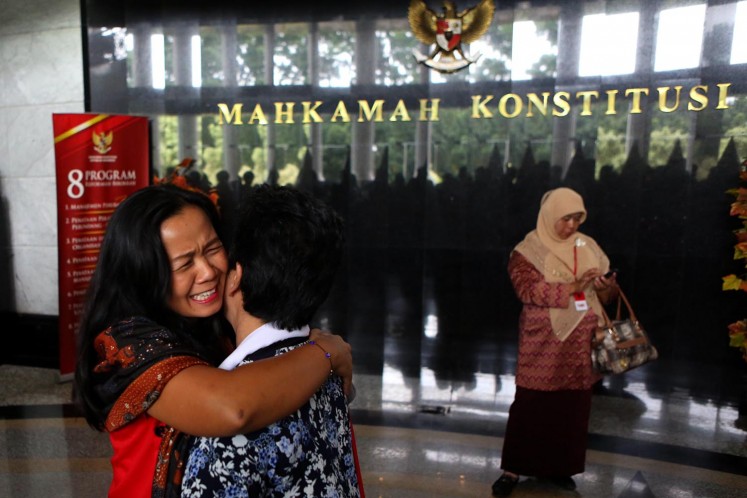 A women's rights activist cries with joy after the Constitutional Court (MK) rejected a judicial review petition demanding that articles on adultery in the prevailing Criminal Code be expanded to include pre-marital sex and same-sex relationships in this Dec. 14, 2017, file photo. (JP/Seto Wardhana.)
How do you respond to the criticism over the homosexuality articles in the criminal code bill?
You have to understand that LGBT was regulated in the Dutch criminal code, though it only regulates crimes committed against underage victims.
For the new regulation, we cannot [criminalize] a person [for his or her sexual orientation]. Instead, what we regulate is their [sexual practice], whether it is conducted in private or in public.
We are prohibited from raiding dormitories one by one to see whether or not there are two people in the same room. That is a private matter.
For the Republic of Indonesia, it is not possible for the government to intrude on the private matters of its citizens. But when private matters disrupt public matters, we have to enforce the law. For instance, when a person [engages in LGBT practices] to disrupt public order. We are not a liberal country.
But the morality articles are open to different interpretations.
We cannot measure it subjectively, because it is related to morality. At the end, it is the judges who will assess [each case]. The legal process at this stage must be very strong.
Besides, one can also be charged with a crime of homosexuality if one commits it by spreading pornographic content, especially if the victim is a child; the sentence would be very heavy. We are aware that the distribution of pornographic content has been rampant here.
So the implementation of the new KUHP provisions depends on the capability of individual judges?
Not only the new norms, but all provisions in the criminal code. The judges will also decide whether to sentence a convicted criminal to jail or only to community service.
The implementation of the community service sentence could also address the problem of overcrowded prisons. For instance, when one person is sentenced to one year in prison, it is possible for the sentence to be replaced with community service or supervision by authorities; or even with a mere fine. The community service sentence, however, cannot be applied to serious crimes.
 Burned down: A fire razes the Jambi Class II A Penitentiary during a riot in March last year. (Courtesy of Tribunnews.com/File)
Some NGOs said the increasing number of crimes regulated in the criminal code bill would increase the current problem of prison overcrowding.
We have to bear in mind that the biggest contributor to prison overcrowding is drug convicts, at around 80 percent.
The Narcotics Law must be revised. We have drug dealers and users, but should we sentence them all to prison? We have to decide which who is better placed in a rehabilitation center, to be placed in prison, or even to receive the death penalty. Regarding the death penalty, we have decided that it is an alternative punishment.
What do you mean by ‘alternative punishment’?
An “alternative and special punishment” means it is dependent on what we call the probation period. For instance, if a death-row convict behaves well during the period, say 10 years, [a death sentence] could be replaced with a life sentence.
What about the adultery articles?
There is an expansion from the old criminal code that criminalizes only sexual acts outside marriage by married individuals.
We want to accommodate the needs of our heterogeneous society that holds [its own] values. We cannot equate our society with Western societies that have broader freedoms, like Europe. We have our own cultural values.
After we decided that the crime can also be reported by any affected third party, it triggered widespread debate. Komnas Perempuan [National Commission on Violence Against Women] was even concerned that it could prompt the persecution of women.
Afterwards, we decided to limit the “third party” definition to the parents, a husband or a wife, or a child of the person who commits adultery.
The restriction has been added to the article. Komnas Perempuan was present at the hearing when we changed the article, and said that they agreed on the matter.
What about the articles on insulting the head of state?
We are bound to the basic principle that the right to freedom of expression is protected under the Constitution. We don't want it to be curtailed by the existence of a new KUHP.
What is regulated in the new KUHP is different from the last one [the Constitutional Court abolished it in 2006]. We have provided an exclusion on people who cannot be prosecuted using the article. For instance, the article cannot be applied to a person who expresses an opinion or criticism on a government policy.
What we mean by “insult” is when a person degrades the dignity of a head of state. For instance, by calling the head of state “a dog” or anything that is not related to what a president does. We have created a long explanation on this matter, so that law enforcement authorities can differentiate between an insult and criticism.
source: www.thejakartapost.com